

imaginary walks
nostalgia and brain exercise through spatial imagination

“One kind of walking which I do not recall seeing mentioned anywhere in the literature of the subject is imaginary walking.” - Edwin V. Mitchell

Open the front door, take the two steps down and start walking to the right. Continue walking to the end of the street, where you will see a small shop on the corner. Notice their LED sign in the shape of a key saying “open”. Cross the road using the crosswalk on your left and continue in the same direction. There will be a roundabout in front of you and tall apartment buildings on your left. When you reach the corner of those buildings at the roundabout, continue left. You will walk past the building entrance and continue straight alongside the parked cars on your right. When you reach the end of the pavement, cross the street going straight and then immediately, using the crosswalk on your right, turn right and cross the street. Walk the length of this long street, noticing the garden boxes filled with volunteering equipment and food donations in front of the third or fourth house. Look across the street to your right and notice the tallest building in this area, thinking about all the students who are staying in its student apartments. Now look to your left to see if there are three women sitting in camping chairs in front of their house on the street, chatting away in the sun. Keep walking straight, crossing the roads as necessary until you reach the cemetery. Enter and stroll around for as long as you please.
What I have just described used to be one of my favourite walking routes in the town where I lived in the Netherlands. Yes, you did read correctly that I walked to and through the cemetery. I promise I am not a psychopath. This town had perhaps the most nicely maintained and peaceful cemetery I have ever been to, so it quickly became one of my favourite places to walk. I no longer live in this town, so it has been several months since I was last there, but I have, since moving away, walked this route many times. Whether it has been as I lie in bed, about to fall asleep, or as I sit in the car, looking out the window into the landscape, I can take myself on a walk in this town as if I was truly there. It may be this route, or the one leading to the nearest park, or the one leading across the border to Belgium, or the one winding through the town, or one of my many others. It depends on what kind of mood I am in.
We walk every day: from the bed to the bathroom, from the bus to work, from the restaurant to the car, through the grocery store etc. Walking is an essential part of our lives, but it tends to be mostly utilitarian rather than an intentional activity. This other form of walking, doing so as a hobby or an activity, became a crucial part of my daily life in the past few years for many reasons. While it is perhaps unthinkable that something which we do everyday anyways can be so transformative for one’s life when our perspective on it shifts slightly, walking has done that for me. Why should we even walk more than we need to rather than just going to the gym for an hour? Let’s start there perhaps.
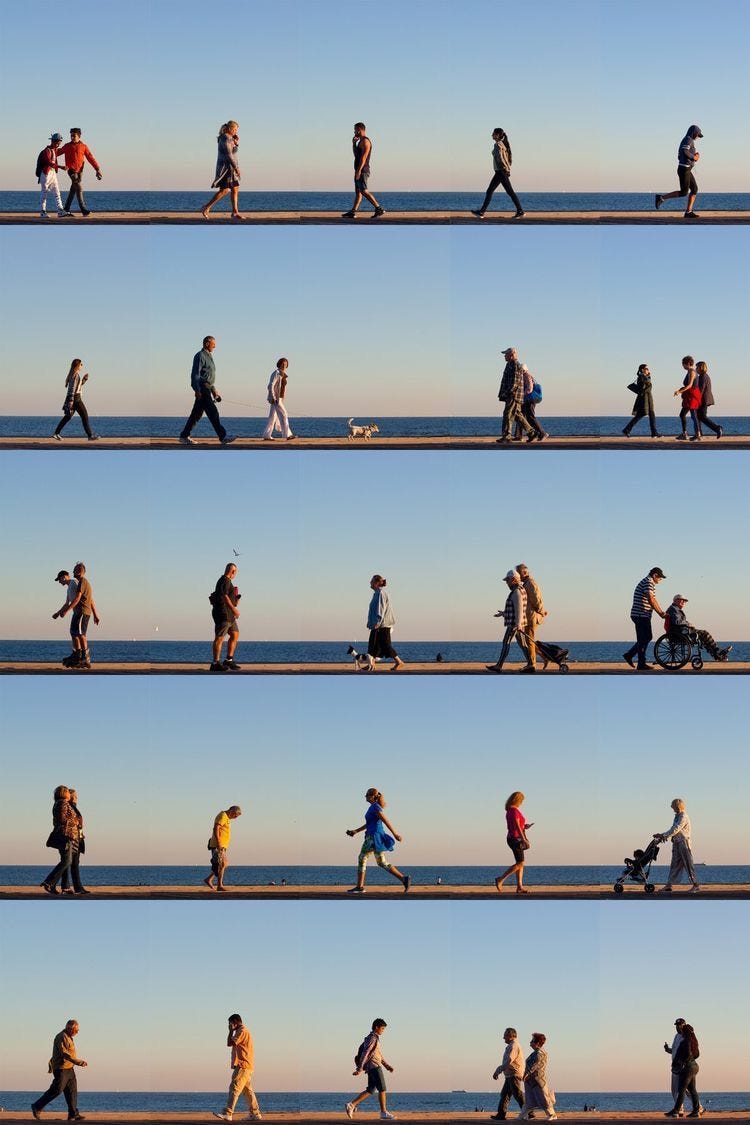
If we consider a “motor-centric” view of the brain, like that of neuroscientist Shane O’Mara for example, we can argue that our brains evolved to support movement. Simply put, if we don’t move, our brain won’t work as well. Thus, if that is true, “our sensory systems work at their best when they’re moving about the world” (Fleming, 2019, para. 5). When walking, our senses sharpen, we are more creative, new rhythms occur in the brain, and our brain interacts with our body in a different way. One of these rhythms are theta brainwaves, for instance, which increase during movement. They assist with learning and memory, and increase during movement because we need them for spatial learning. Not all movement is ideal, however. O’Mara speaks of the common formula of sitting at the office all day and then trying to make up for it with one intensive hour at the gym as “a terrible mistake” (para. 11). It is not about doing one hour of intensive exercise and then doing nothing after, but rather about consistency and lower intensity. And that is where walking comes in (pun not intended). It is the most accessible form of movement and that which is most easily woven into your day. Furthermore, it is the most ideal form of movement to get our brains working.
Walking is not only beneficial for its movement aspect, though. As you walk, you look around, you notice things, you navigate your environment and much more. The cognitive mapping system that allows you to do that is one of your silent senses (Fleming, 2019). It builds itself without you even noticing and you only ever do notice it when it stops working and you get lost. This system of mental mapping works using place cells, which are in your hippocampus. When you are not moving, the cell coding for that certain position is firing. When you begin moving and change position, that first cell stops firing and a cell marking your new position will begin firing, then the next one etc. It seems simple, but a challenge for the system, for instance, is funnily enough walking in one direction. To help the system recalibrate, you need to look around and give it visual cues and checkpoints, so that it knows more than the single direction in which you are walking.
Simultaneously with this system, your ‘social brain’ works to analyse other people around you, to predict their movement and prevent collisions. The aforementioned creativity benefit of walking also arises here. As you walk, your brain needs to switch between various regions in a similar manner in which we “mentally time travel” between “big-picture states” and “task-focused work” to make associations (Fleming, 2019, para. 17). In simpler terms, your brain constantly flips between thinking about what you have to do tomorrow, to what the pavement looks like in front of you, to what your plans are for next year’s vacation, to how to avoid colliding with the people around you. This switching is the “mental time travel” that allows you to make associations, and walking supports this brain region flickering mechanism.
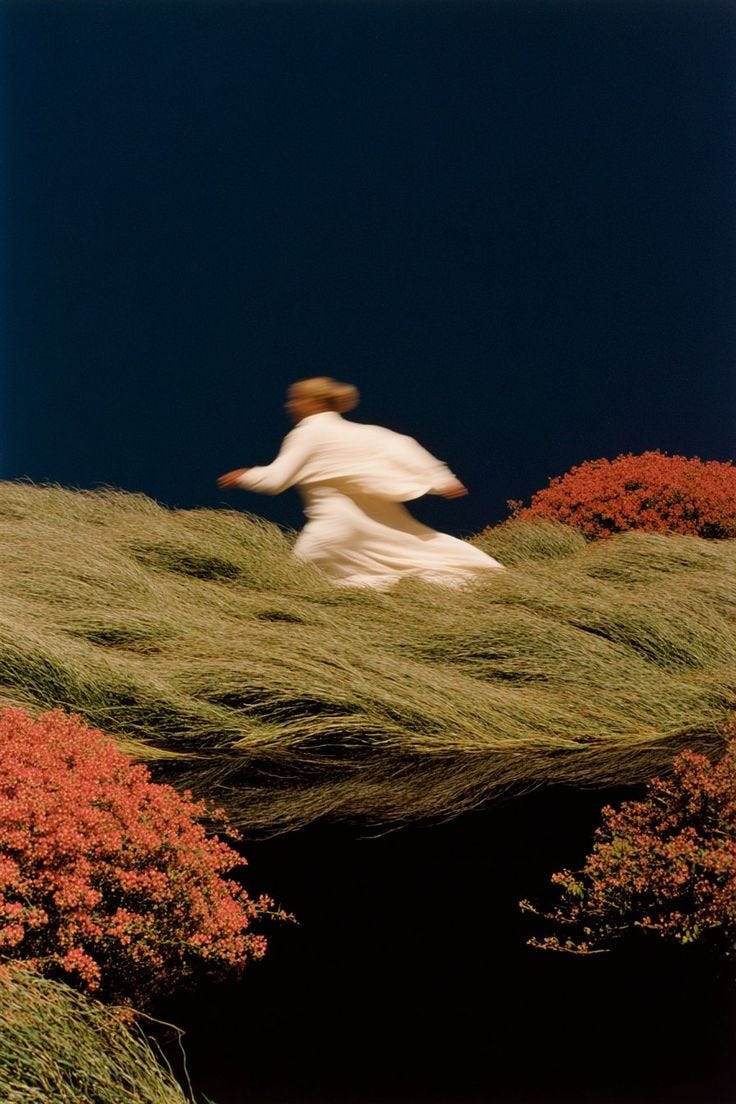
What about the environment in which we walk? Author Annabel Streets pushes forth the argument that walking does not always have to be done in nature and green spaces to be beneficial (Chaudhuri, 2025). “Urban spaces are often much more stimulating and energising than more remote landscapes” (para. 13). Where green spaces may calm us down, “cities can perk us up, pique our curiosity and trigger our imagination” (para. 13). In fact, often a walk in the city can be more beneficial than a walk in nature, because the variety of stimuli around us help distract us from our constantly ruminating minds. This has been explored in a study by Wang and colleagues (2023), who have found historical walks to be just as psychologically restorative as walks in green spaces, due to the aesthetic impacts of these sites on our brain. Thus, perhaps the most important takeaway from this is that environment does not necessarily matter as much as we think it does. Living in the city is not an excuse not to go on a walk. You do not have to be in nature to go walking. Each environment has its pros and cons, and brings with it its own effects on your body and brain.
“I start each week by thinking, OK, what do I need this week? Do I need space? Do I need the comfort of trees? Do I need to be in a more enclosed space? Do I need to be near water? The more you learn to listen to your body, the more you will learn where you body wants to be. Do you want to be somewhere green, do you want to be somewhere historic? Do you want to be in the cemetery? I go to cemeteries a lot because you don’t always want to be in a happy place or mood.” (Chaudhuri, 2025, para. 19)
(*as I wrote above, I also love going on walks to cemeteries)
Now, take into account everything that I have written above about walking, and consider that evidence has found the effects of real walking and imagined walking to be similar (e.g. Stolbkov et al., 2019; Blumen et al., 2014). Therefore, the above should also apply, at least to some extent, to imaginary walking. Think of it like the popular guided meditations where you are instructed to escape to your favourite, or to some specific, location simply with the power of your imagination. Entire imaginary walking programs have been created in a similar manner. These can either be fully stationary and imagined, only guided through audio, or with movement on a treadmill and supplemented by paper trails allowing walkers to cover imaginary routes (Salter, 1991). There really is no exact formula for how to do imaginary walking.

The School of Mental Health Ontario uses imaginary walks for students, to calm their nerves or tension before exams. Going off of research (Domitrovich et al., 2007; Felver et al., 2016), this method helps their students attune to their internal state and, thus, aids them in coping with stress and gradually training their mind to respond to distractions, intense emotions or anxiety in efficient ways. Their website includes instructions for a guided imaginary walk that a teacher can take their students on.
“Breathe out and soften your gaze. Imagine that you are standing in a safe, peaceful forest. Birds are singing in the trees and bushes all around you. You can hear their soothing, gentle songs behind you…to your left…to your right…in front of you…and in the trees above. You breathe in deeply and your nose tells you that it has rained recently. Everything smells alive and full. Up ahead you notice flowers growing beneath the trees. You walk over and lean in to look more closely at one flower. Notice the rich colour of the petals…” (School of Mental Health Ontario, n.d.)
My imaginary walks tend to be more of the fully abstract kind. If I find myself reminiscing on or feeling nostalgic for a time in the past, I take myself on an imaginary walk in the area. Even if I haven’t lived there for several years, I have cognitively mapped my favourite routes in detail, and fully believe that I will be able to walk through them for the rest of my life. Especially in time periods when I cannot get out on actual walks enough, for whatever reason, imaginary walks are a life saver. It may be a stroll in Notting Hill along Portobello Road market all the way to Layla Bakery, if I find myself missing London. It may also be a walk to my favourite place on the fields in my hometown, where I used to escape when I needed a moment alone.
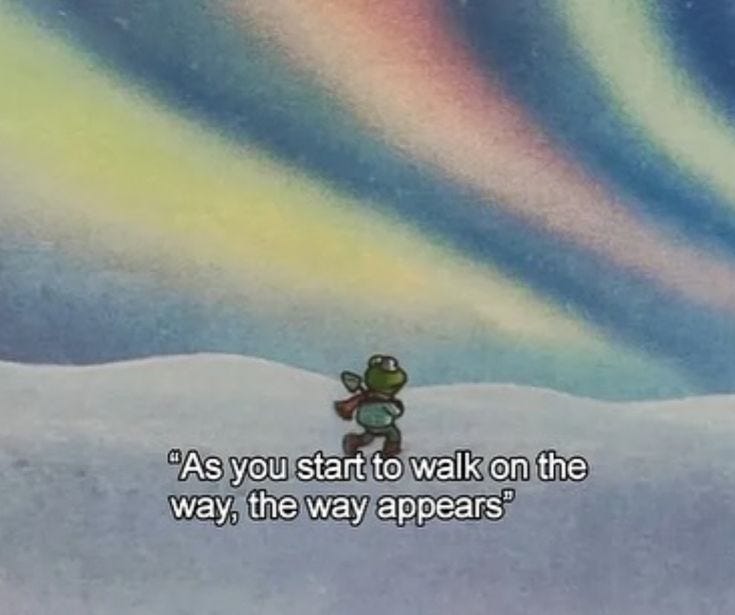
All of us have certain places and routes that we could walk with our eyes closed, so the aim is just to actually do it. When you lay in bed at night and can’t seem to fall into a slumber, perhaps start one of your favourite walking routes in your mind. It may be one initiated by nostalgia for a certain place or time. You may also simply pick the route you take to work or to school every day and see how well you can conjure it up in your mind. Make it a little exercise for your brain. Do not rush it, though. Walk slowly, turn your head, draw out the surroundings in as much detail as you can. Act a bit like those 3D mapping tools that orthodontists stick inside your mouth when they need to 3D map your teeth to make your invisalign. Take it step by step and watch the world render in front of you. Where does your imaginary walk take you?
this is the matcha i drank whilst writing this:

Love,
Adriana
References:
Blumen, H. M., Holtzer, R., Brown, L. L., Gazes, Y., & Verghese, J. (2014). Behavioral and neural correlates of imagined walking and walking‐while‐talking in the elderly. Human Brain Mapping, 35(8), 4090–4104. https://doi.org/10.1002/hbm.22461
Chaudhuri, A. (2025, April 14). ‘Cities trigger our imagination’: why a walk in town can be just as good for you as a stroll in the countryside. The Guardian. https://www.theguardian.com/lifeandstyle/2025/apr/13/go-to-town-the-surprise-feelgood-effects-of-walking-in-the-city
Domitrovich, C. E., Cortes, R. C., & Greenberg, M. T. (2007). Improving young children’s social and emotional competence: a randomized trial of the preschool “PATHS” curriculum. The Journal of Primary Prevention, 28(2), 67–91. https://doi.org/10.1007/s10935-007-0081-0
Felver, J. C., Hoyos, C. E. C., Tezanos, K., & Singh, N. N. (2015). A Systematic Review of Mindfulness-Based Interventions for Youth in School Settings. Mindfulness, 7(1), 34–45. https://doi.org/10.1007/s12671-015-0389-4
Fleming, A. (2019, July 28). ‘It’s a superpower’: how walking makes us healthier, happier and brainier. The Guardian. https://www.theguardian.com/lifeandstyle/2019/jul/28/its-a-superpower-how-walking-makes-us-healthier-happier-and-brainier
Salter, R. (2019, March 10). Imaginary Walks Net Real Benefits : * Fitness: Novel wellness program for companies with little money for them shows remarkable results . - Los Angeles Times. Los Angeles Times. https://www.latimes.com/archives/la-xpm-1991-10-23-vw-356-story.html
School of Mental Health Ontario. (n.d.). Imaginary walk - Guided imagery. Stress Management and Coping - Faith and Wellness - a Daily Mental Health Resource. https://smho-smso.ca/fw/stress-management-and-coping/guided-imagery/imaginary-walk/
Stolbkov, Y. K., Moshonkina, T. R., Orlov, I. V., Tomilovskaya, E. S., Kozlovskaya, I. B., & Gerasimenko, Y. P. (2019). The neurophysiological correlates of real and imaginary locomotion. Human Physiology, 45(1), 104–114. https://doi.org/10.1134/s0362119719010146
Wang, S., Xu, Y., Yang, X., Zhang, Y., Yan, P., Jiang, Y., & Wang, K. (2023). Urban cultural heritage is mentally restorative: an experimental study based on multiple psychophysiological measures. Frontiers in Psychology, 14, 1132052. https://doi.org/10.3389/fpsyg.2023.1132052